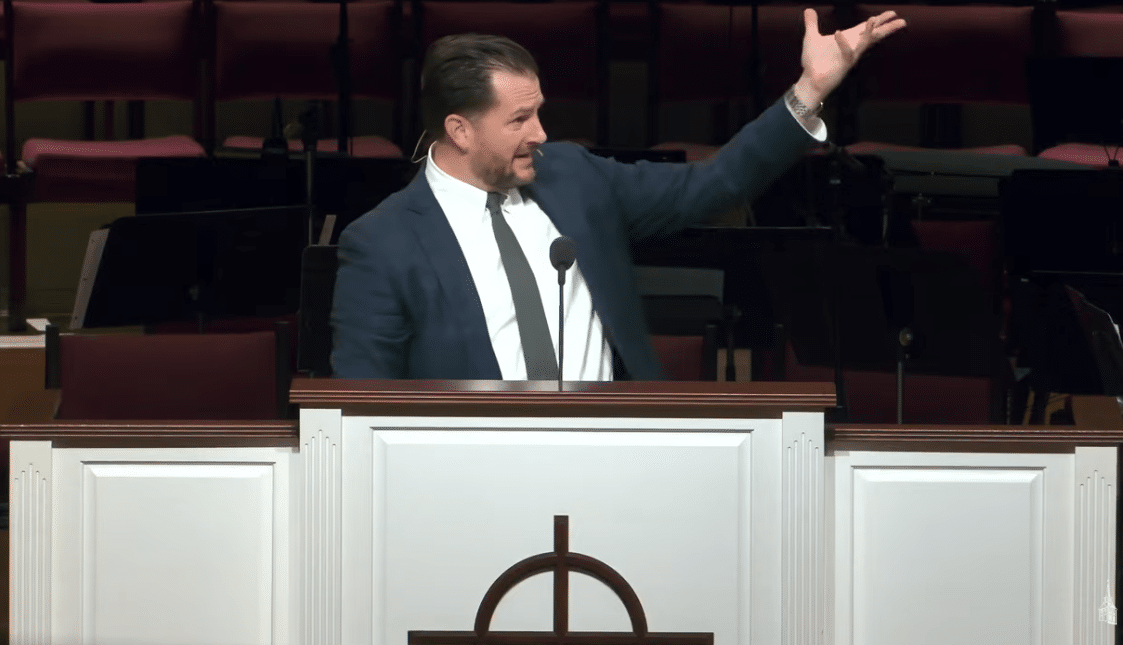
The Spirit of Adoption
Dr. Chad Van Dixhoorn, Speaker
Galatians 4:1-7 | November 22, 2026 - Sunday Morning,
Let us come to God again in prayer and ask for a blessing on the reading and the preaching of his Word. Let’s pray together.
Our gracious God and Father, we bow our heads in worship, and we ask that as we lift our heads, we will continue to worship – that we will worship you as your Word rings out in this place, that we will worship you as we give our best attention to the message of your Word as it’s proclaimed. Help us, Lord, although it only comes from a herald and an ambassador, to hear this Word as though from the mouth of a king, for this is your message for us. And help us, Father, in this day, in this hour, and in this half hour to count these moments as your gifts, and help us not to throw gifts from you away half-opened. But Lord, help us to embrace them and to delight in them as we’re meant to do. And for this, we need your Spirit’s help. So, answer our prayers. Help us now. And we ask this in Jesus’ name. Amen.
Well, I want to encourage you to turn to Galatians chapter 4. Galatians 4. We’ll read the first paragraph this morning. “What I mean is” – if I saw you in the parking lot this morning or at the coffee pot or what goes for a coffee machine here at Christ Covenant, if I saw you and just said, “What I mean is” you would think, if those were my very first words, that I thought we were continuing a conversation. And something like that is going on in the passage we’re about to read. The fact that chapter 4 begins this way suggests to us that the Apostle Paul is mid-conversation with these Galatian Christians, and indeed he is. The Galatians had debated how the Old Testament related to the New Testament, and they got it wrong. They also did not realize that they were ignorant to a dangerous degree about the way in which works relate to grace. And they completely underestimated the privileges that come to Christian people in Christ – old and new, works and grace, Christian privileges. These are three related issues treated in the first three chapters of this letter, and it’s this conversation that continues in the opening paragraph of chapter 4.
After we read the Scriptures, I’m going to encourage you this morning to leave your Bibles open. This is a very rich passage, but it’s not an easy one. And I suspect that if you don’t have your Bible open this morning, you could get a little lost. One of the blessings of being a visiting preacher is I can sometimes choose complicated passages, and if you don’t understand them, it’s really your pastor’s job to sort it out in the week that comes. But I want to minimize their workload. So, keep your Bibles open with me this morning. Galatians 4:1.
“I mean that the heir, as long as he is a child, is no different than a slave, though he is the owner of everything. But he’s under guardians and managers until the date set by his father. In the same way, we also, when we were children, were enslaved to the elementary principles of the world, but when the fullness of time had come, God sent forth his Son, born of a woman, born under the law to redeem those who were under the law so that we might receive adoption as sons. And because you are sons, God has sent the Spirit of his Son into our hearts crying, ‘Abba, Father.’ So, you are no longer a slave but a son. And if a son, then an heir through God.”
This is the Word of the Lord. In the mid 1500s, Mary, Queen of Scots, made a series of poor life choices. These included adultery and murder. And since the Scots had ethical expectations for their leaders, this impacted her credibility as a ruler, and eventually she fled Scotland and left her two-year-old son, James, on the throne as king. The young James was king. He was the heir or the inheritor of everything royal in Scotland. But as he grew up at this young age, he did not get to decide where he would live. He did not get to decide when he would travel or what he would learn or who would be his teachers. So long as he was a child, he was under guardians and managers, and he had to do what he was told, and he could not grasp the riches. He could not touch what was his by inheritance. The date that James became an adult was determined by law. And in the days of the Apostle Paul, the Jews thought that someone became an adult around age 12. The Romans thought age 18. The Galatians said it was whenever the father said so. But in all of these cultures, the heir of everything was in charge of nothing. He was in charge of nothing until the appointed time. In a sense, they were on the same level as the household slave or servant, at least in terms of their freedoms and their possessions. And that, the Apostle Paul explains to us this morning, that Scripture says to us in verses 1-3 is just how it used to be for Paul and the Galatians, for the Jews and the Gentiles. For when we were children, we were enslaved, he says, to the elementary principles of the world.
Now, I think most of us can pick up most of what we need to see from these different analogies that are provided here, but for all of us to best understand Paul’s point, we need to answer, I think, three questions. First, does this talk about childhood and slavery refer to the people of God under the Old Testament, the way it used to be? Or does it reflect the situation of any sinner without the Savior, the way it always is? Or both, as seems to be the case in chapter 3? Second question, why does Paul say we were children? Paul is a Jew. He’s writing to Gentiles. What in their experience is similar, either historically or personally? Third, what is meant by the puzzling phrase “slavery to the elementary principles of the world”?
Let me tackle that last question first. There are four places in his inspired writing that the Apostle Paul uses this phrase – here and in verse 9 and twice in his letter to the Colossians. And each time he has in view human traditions that are given religious value. Each of the other times that he mentions the elementary principles, he warns against them or against valuing them, because somehow these things pretend to provide some kind of hope or confidence apart from Christ. If elementary principles are human traditions or practices that are given religious value by people, then that in turn explains why the Apostle Paul can say “we.” The Apostle Paul can say “we” because, although he and the Galatians have different backstories and different backgrounds, their lives had shared a similar principle or dynamic. As a Jew, he could feel the pull of practices that no longer had any value. And as Gentiles, they could still feel the tug of old pagan traditions that never had any value. Jewish traditions appeared to have more merit because God had commanded their use for a time, a long time. But once Christ came to fulfill those ceremonies, those traditions, they became for those who persisted in them mere human traditions, useless as Gentile practices were. And it was a form of slavery to keep doing these things, to keep finding value in them.
Still working backwards, the answer to the second question about the word “we” finally answers that first question about childhood or slavery. For the Jews, Paul is once more pointing out a contrast. On the one side, the old covenant life of underaged children is set before us and a slavery to ceremonial laws. On the other side is a New Testament life of adults and heirs that we have in Jesus Christ. But for both Jews and Gentiles, the Apostle Paul is also describing something of a crisis. The plight of a sinner facing all that life brings and all of eternity without a Savior, and a crisis because people are trying to solve their struggles in this life and to prepare for eternity. People are trying to determine their struggles with guilt or shame or emptiness but without coming to Christ for their righteousness and dignity and glorious hope. And it’s because the Galatians, because people like us look for help and for answers in the wrong places that this is a universal problem. It’s why Paul says “we” were children. We were enslaved.
I was a poor math student. I wasn’t just a poor math student, but I only wish to confess one thing at a time. I was a poor math student, and my biggest weakness, so far as I could tell, was algebra. But I learned at least this. When the lefthand side of an equation has an unknown variable and the right side of that equation has what I think of as an answer, you can use the answer to solve the variable. Something about inverse operations still comes to mind. We can know how to understand the questions or the variables in verses 1-3 because of the answers that we see in verses 4 and 5. It’s verse 4 that tells us that at the right time in history, God sent forth his Son and that the sending of his Son changed everything. God’s eternal Son also became a woman’s son. The divine Son of God became one of us. The second person of the Trinity was born under the law – his law – and was thus placed in our situation, and he submitted himself to the very law that he had made. Verse 5 tells us God’s Son came and did all this to redeem people who were under the thumb of the law, under the heel of the law. And he did so. He paid the penalties, all the penalties that the law required of those who did not keep it. Verse 5 also tells us that we’re not only redeemed from something bad, we are redeemed to something wonderful. You can see it right there in the passage: God sent his Son to make us sons. He sent us a Redeemer so that we might be adopted as sons. And summarizing the glorious constants stated in verses 4-5, we can kind of check our work in verses 1-3, and it comes out wonderfully. Before the time appointed by the Father, there was always something servile, something slave-like, in the way in which God’s people lived. At the very least, something immature. And Paul knew that this wasn’t just a Jewish “me” problem. It’s a Gentile and Jew “we” problem, because all of them and all of us naturally find ourselves chasing some kind of a works principle, some kind of salvation by trying harder or doing more, some way to divinity designed by humanity instead of finding redemption in Christ. All of us trying to find our identity and our hope in something other than belonging to God, other than being adopted into his family because of Christ.
The final two verses of the chapter represent the mountaintop of Paul’s presentation of our redemption. And I know I’m mixing my metaphors, moving from Scottish royalty to mathematics to high elevations, but I can hardly think about these verses in any other way than as the summit of Christian theology or one of the high points. For in verse 6, we’re told that God not only sent his Son to make us sons, but that he also sent the Spirit of his Son to give us joy and confidence in our sonship. He gave us the Spirit so this sonship wouldn’t be wasted upon us. And then in verse 7, we’re told what should no longer be a surprise. We are no longer slaves in Christ. We are full heirs, adopted to inherit everything that God has always planned for us. By the way, the mention of heirs again and again explains why Christian men and women, Christian boys and girls are all called sons. In the ancient world, property was kept in the family line by giving it to sons, usually just the eldest son. He would get the inheritance. In calling us all sons, God’s Word is making an important point about our blessings in Christ, about our equality in Christ. Just as in Ephesians, all Christians, male and female, are called “the bride of Christ” to assure us that we’re all equally loved, all equally precious. So in Galatians, all Christians, male and female, are called “sons” to assure us that we will all equally inherit what God has prepared for us. We are all to have life one day where we will not only walk with God as did Adam and limp with God as we do now, but we will live with God in the fullness of all that he’s left for us in his will.
We’ve climbed rather quickly to verse 7. Don’t think the sermon’s almost over just because we’ve reached the top. It’s now time to look back and see where we’ve been. Along the way we’ve moved from the old covenant to new. We’ve glimpsed too briefly in passing the glorious incarnation of our Lord. And we saw the doctrine of redemption. And from at least three different angles, we’ve glimpsed the doctrine of adoption. Indeed, adoption or sonship appears in these verses to be the main thing that we’re to notice. First, the Son redeems those under the law in order that they might know the adoption of sons. Second, it’s because of our sonship that we experience the ministry of the Holy Spirit in all of its fullness. And finally, it’s because we’re no longer slaves, but real sons that we are told that we will inherit through God.
While we could profitably consider any number of biblical truths and teachings in this passage, I want us to use the remaining time to rejoice with you in this reality of adoption, which we have because we have Christ. Adoption is sort of the Cinderella doctrine of the Christian theological system. If you’re new to church, you might have heard of many doctrines by now, but maybe not this one. It’s the neglected stepsister of justification and sanctification. It’s often overlooked and unmentioned. And yet, in our passage, it’s clear that God himself does not see adoption that way. No, look at the way in which the Bible lingers over this. We can see that the Lord has a different perspective than we might. And to help us just see how different our perspective sometimes is, it might help to say aloud what Christians often think and sometimes say. No harm done, but if someone asks us why God sent his Son into the world, what might we say? I think many of us might first say that God came or God sent his Son Jesus Christ that we might be justified. And that would be a great answer because it’s to the point and has the benefit of being true. Christ came so that we might have counted to us by sheer mercy the righteousness that is properly Christ’s, so that we might have the forgiveness that by rights should never be ours. And writing to the Romans, the Apostle Paul himself says that Christ was delivered up for our trespasses and raised for our justification. And because the Holy Spirit unites us to Christ by faith, what he has done becomes ours. Through union with Christ, we are justified. Perhaps if you’re remembering the passage we read earlier in the service, you might want to add to that. You might say, as Paul does in Ephesians 2, that by grace we’ve been saved, by faith, and we might go on with Paul to say that we are his workmanship, created in Christ Jesus to do good works, which God prepared beforehand that we should do them. And because the Holy Spirit unites us to Christ by faith, what he has earned for us becomes ours. Through union with Christ, we are being sanctified. But again, what’s so interesting is that in writing to the Galatians, although they were in a muddle about justification and were not getting sanctification right, the Apostle Paul mentions not only justification and sanctification, but here he mentions adoption at the center point of his letter. Christ came to make us children of God. Our elder brother, as Hebrews calls Jesus, came to bring us to his Father, who is now our Father. It was his purpose not only to justify us, not only to sanctify us, but to bring us into his family so that we might know him and a host of other brothers and sisters with him. And because the Holy Spirit unites us to Christ by faith, what has always been true for him becomes in a profound sense true for us: through union with Christ, we are adopted into our Father’s family.
I find it important that the Apostle Paul corrects the Galatian errors about justification and sanctification elsewhere in this letter. I find it instructive that he also turns to the doctrine of adoption. And I wonder if we can learn something from the Apostle Paul’s pastoral pivot here in verses 1-7. Many of you will remember that the Galatian problem that led the Apostle Paul to pick up his pen and write this inspired letter was a dire one. The Galatians were unsteady. Some were sliding back into old ways of thinking. Some were being pushed into either pagan ways of thinking or old covenant ways of thinking, and both ways of living and thinking made similar mistakes. As Paul has already explained, these churches in the Galatian area had turned back to their own traditions, their old religious routines, insisting that the mature Christian – some of them were even saying a real Christian – would not only look to Christ for faith and everything that comes from him, but would also complete a kind of checklist of things that would make them pleasing to God. And that was a problem. For the Jews who were still trying to obey Old Testament traditions, it was a bit like going to the DMV with expired paperwork. They’re trying to check boxes on an old, dated form that was issued before the fullness of time, and when they come up to the counter, they’re going to be told they’ve got the wrong one. They’re working on the form that was issued before Christ came. For the Gentiles who were never following proper traditions to begin with, it was like using the DMV form from the wrong country or state. It never would have worked. But the main point is that the proper form comes with all the boxes already filled out, all the requirements met. Christ has fulfilled all that the law requires. That’s the one thing that they needed. They needed what he had to offer, and the old was not – is not – accepted at all. I recognize that using the DMV in North Carolina to try and explain the wonders of the Christian gospel is a bit of a mistake. Not everyone’s experience at the DMV goes swimmingly well, but I hope you get the point, and later you can help me come up with a better illustration.
Well, the most obvious way to correct the Galatians was to address directly their errors regarding justification and sanctification. But there’s often more than one way to get to the heart of an issue. There are any number of spokes that all lead to the hub of the issue. And rather than point out again what they were not seeing correctly, the Apostle Paul chose to highlight what they were missing completely, because this too could get to the heart of their problems. An old preacher named John Brown once commented that there’s an unhappy disposition or tendency in mankind to overlook and underrate the advantages they already have. The Galatians had underrated their privileges and freedoms. By the way, so do we when we submit to man-made or self-made rules about the Christian life or old practices that don’t really have any value at all – things that are barely good for the immature and certainly are no longer relevant for us. Philip Ryken comments that for Christians to go back to legalistic ways of thinking – maybe some background you’ve come from and maybe even keeping Old Testament ceremonial laws – is like a PhD repeating kindergarten to learn his ABCs. There are Christian traditions that emphasize rituals for God more than relationship with God. Drifting towards these is no sign of enlightenment or maturity. It’s a sign of slavery. It’s weakness, not strength.
The Galatians had also overlooked their status as God’s children. By the way, so do we when we try to make ourselves pleasing to our Father by what we do, when we are already adopted into his family, when the Father’s smile is already upon us, when he has already accepted not only our persons in his Son, but all our endeavors for his glory. God has sent his Son to make sinners his children. Do you see that this morning? Do you see how those who understand this truth are no longer strangers and orphans? Do you see how he has purchased your adoption papers? Do you see that he’s done all this so that you would be his and he would be yours? The Father loves you now. The Father cares for you today. You are his child this morning. If you look to Jesus of the gospels, the Lord who is alive and reigning and returning – the Father is yours, and you are his.
The Galatians, or at least the Galatians who are Christians, already had the advantage of the Spirit of God too, but they were not enjoying this gift either. So will we lose our joy if we forget that every Christian is adopted to glorify God and to enjoy him forever and that God has done everything needed to make that possible. If Christ is yours, then the Father is yours, and so is his mighty and powerful and comforting Spirit. Because of our adoption, the Spirit of the Son becomes the Spirit of every son and daughter of the king. By the Spirit of Christ, God speaks to us. Our Father testifies to us that in the face of our sin, repented of, our suffering endured, we belong to the Father. By the Spirit of his Son, he helps us to speak to him as he’s already done in this service. Maybe you struggle to pray to God as your Father, to speak to him in that intimate way. Maybe, like people in John Calvin’s day, you find uncertainty that keeps our mouths half shut so that half-broken words can barely escape from stammering tongues. Maybe you don’t feel like you know how to pray to your Father in heaven as you should or could. If so, the Holy Spirit can help you find your voice. Ask for that help, and he will inhabit our hearts and help train our lungs and get our vocal cords to speak to the Father in our own tongue. That’s part of what is meant in verse 6, when Paul uses two words with the same meaning, so that Jew or Greek might be sure to understand what he means. The Spirit will help some to call him abba in Aramaic, others to say pater in Greek, or for us to say “father” in English. By the Spirit of the Son, we’re given a new voice, a new boldness to speak to God. We don’t come to him as those who are groveling before a stingy trustee or cringing before a brutal tyrant or whispering in the presence of some monster. We come with a confidence to speak or to cry, to sing out, even to call out. That is what’s taught in verse 6 when we’re told that we’ll be able to cry out to our Father. We can cry out to him for forgiveness, we find out. We can cry out to him for help and receive it.
The Galatians had also overlooked their inheritance. So do we when we forget that everyone resting in Christ at this moment already is an heir of all that the Father can give and will give. To the extent that we forget the truth of verse 7, to the extent that we live as slaves instead of sons or as those underaged instead of those who are adults, to that extent we forfeit a joy which the Father wants us to see is ours. We’ll be like someone who’s crossed the finish line in a race without really noticing it. Just gasps on, hoping to get there, when the crowd’s trying to tell them that they’ve already done it. Or like the person – and who knows anyone like this? – who calls a family member to ask if they’ve seen their phone anywhere or uses Find My Phone and then sees it ringing in their hand. We’re trying to perform for the Father’s approval when the deed is already signed, the Son has already died, the terms are already declared to all who will inherit eternal life and glory and joy that God the Father has prepared for even the least of his children, for people like you and me. Every gift of God is a wonder of grace, and each gift comes to every person who’s united to the Savior by a Holy Spirit-worked faith. But many Christians, once they understand Galatians 4, experience this gift of adoption into Christ’s family most keenly and treasure it most deeply. Admittedly, there are few greater joys than knowing that one is justified. To hear the verdict that we’re forgiven and righteous, as righteous in the sight of the judge as any person could ever be. Likewise, it’s a great thing to be sanctified, to know that the great physician is at work – cutting, stitching, doing all that we need. The disease is leaving. The mortal illness of sin is mortal no longer.
But neither piece of good news is fully realized and enjoyed outside of the context of adoption. There’s a different sort of happiness that we find in a family than in the courtroom or the doctor’s office. Those who have been blessed with good parents can imagine the qualitative difference between leaving the judge and the courtroom, between leaving the doctor and the doctor’s office, no longer with fear but celebrating by yourself. How different that is than going home to a family, to singing out the truths of our redemption here with all of us, rather than just by ourselves. What a freedom it is to have a family. What a joy it is to be able to address God as our Father even though he’s in heaven, and we’re on earth. What an honor it is to be joint heirs with God’s Son. And what a privilege – what a privilege – to have brothers and sisters from every continent and corner of the globe, for when we think of God the Father, we must always in the end also think of one another. Our most basic alignment is of course to God himself. He is the one we adore and worship. It is in in him that we trust, and we owe him the loyalty of our hearts. But our second most important alignment or relationship is with his children. We are God’s family – one family, with one elder brother, one spirit of adoption. And for that reason, Christian brothers and sisters ought to do all that we can to foster love and unity in this family, seeking one another’s good, holding back from criticism of fellow members of the household of God when we can. And because we’re his children, the Father will help us in all of this too.
Some of you will have heard the story of John Wesley’s conversion. Wesley was an Anglican clergyman, living unhappily, without confidence that he was a Christian while living very busily, beyond many in his own day. He even did a stint as a missionary. Many would have found him very impressive. He was just so earnest. He did so much. But in May 1738, gathering with a group of Christians in London, he heard someone reading something written by Martin Luther about 200 years before. And for the first time, Wesley experienced the peace and the joy of a child of God. He believed that at this moment he was born again. Wesley later reconsidered this assessment and upon reflection and some years’ distance, it became less clear to him what had happened that night, whether he had actually become a Christian in 1738. What was clear, he said, was that once he had the faith of a slave, but that night in London he had for the first time the faith and joy of a son. Now, my reason for telling you this story is not to recommend to you all much of what Wesley had to say about the way of salvation. He could sometimes be quite unclear. I mention his experience because I think that there will be those here this morning who have some sense of what Wesley was talking about, some sense of what he meant in those later reflections. Many of us struggle at least sometimes with a slave-like mentality. Christian siblings are our rivals. We suspect our Father is always frowning, but these things are not true. Do you trust in Jesus Christ? Then however imperfectly it may be carried out, your Christian family loves you. Do you trust in Jesus Christ? Then however hard it is for you to see, your Father cannot love you more. Indeed, he will not love you more in eternity than he does right now in time. And let this one truth persuade you: surely if the Father has given you his own Son and his own Spirit, then he has redeemed you to be his child with all that he counts most dear. Let us come to him with thanks for these truths.
Our gracious God and loving Father, from this day forward, let us never doubt but believe that your gifts to us are the measure of your love for us. And to that end, help us to see ourselves as we are by faith, united to our Savior, and train our tongues not to speak and pray to you only as our God, but to speak to you, to cry out to you, as our Father. Would you do this by your Spirit? We know that you will, because we ask it in Jesus’ name. Amen.