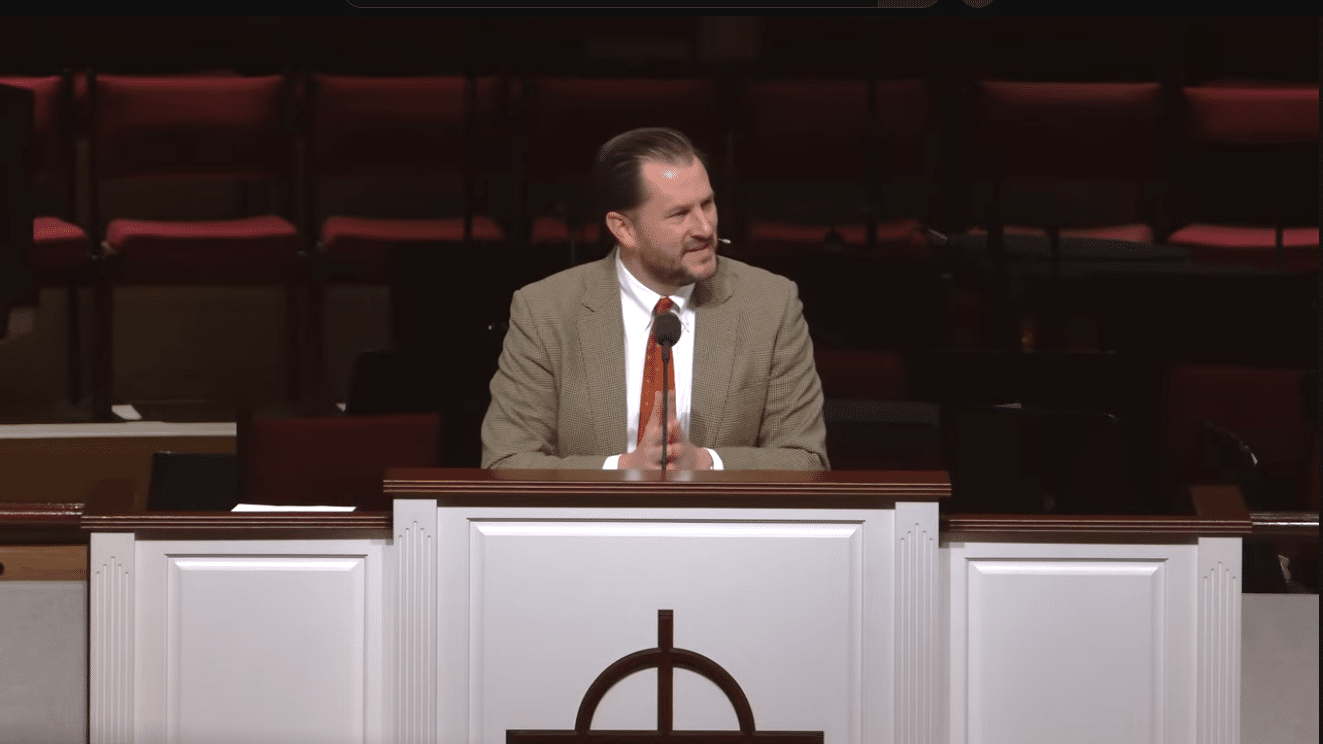
Infallible Rule or Infallible Ruler? The Courage to be Satisfied with Scripture
Dr. James Anderson, Speaker
| November 15, 2025 - Faithful Conference,
Our second session tonight, glad to have colleague and friend James Anderson. James is a professor of systematic theology here at RTS Charlotte. His specialty is in philosophy and apologetics and ethics, so he handles those courses here. And a special interest he has in Van Til and presuppositional apologetics. His session tonight will talk in large measure about the papacy, and so let me mention this fine book. This is a new series, a continuing series put out by Lexham Press, going through the doctrines of systematic theology. This new one, One Holy Catholic and Apostolic Church. So, this is the doctrine of the church by Guy Waters. He’s a professor at RTS Jackson. And so, this is a very fine book. And to remind you, if you have questions, you can email [email protected]. So, glad to have James with us. Welcome. We look forward to hearing from you.
Well, good evening, everyone. It is good to be here with you. I’d like to invite you to join me for a moment in a thought experiment. Imagine that you have been given the task of refuting Christianity. Which doctrine of the faith would you target? Which doctrine is such that if it were disproven, the Christian religion itself would collapse? We might think first of the doctrine of Scripture, the divine inspiration of the Bible. If the Bible isn’t the Word of God, then we lose the foundational authority for all of our other doctrines. Or perhaps in this year, when we’ve celebrated the 1700th anniversary of the council of Nicea, we might think of the doctrine of the deity of Christ. Or closely related to the deity of Christ, we might think of the doctrine of the trinity. Could there be any more distinctively Christian doctrine than that? Indeed, there are many answers that we might give to that opening question. But arguably the one that the Bible points us to directly as one of the lynchpins of our faith, one of the supporting pillars of the Christian gospel, is the doctrine of the bodily resurrection of the Lord Jesus. As Paul famously writes in 1 Corinthians 15, “If Christ has not been raised, your faith is futile, and you are still in your sins.” If the doctrine of the resurrection were proven false, Christianity would be dead in the water. Now, fortunately for us, there are solid grounds for believing that doctrine. There is compelling biblical, historical, and theological support for it. If you want the details, come to my apologetics class this January.
But now consider a somewhat different question. Is there a doctrine that functions in the same kind of way for Roman Catholicism? Is there a doctrine distinctive to Roman Catholicism such that if it were disproven, Roman Catholicism itself would collapse. Certainly, there are many doctrines that are distinctive to Roman Catholicism – the doctrine of transubstantiation, the doctrine of the seven sacraments, the doctrines of purgatory and indulgences, the doctrine of the immaculate conception of Mary, the doctrine of the bodily assumption of Mary into heaven, and so on. But I would suggest that none of these are as foundational to and as definitive of Roman Catholicism as one particular doctrine: the doctrine of the papacy. The doctrine of the papacy is what undergirds the claim of the Roman Catholic Church to be the one true church, the one vessel of salvation. The doctrine of the papacy is what undergirds the claim of Roman Catholicism to represent true Christianity and to regard non-Catholics, whether Protestant, Eastern Orthodox, or any other tradition, as separated from the body of Christ. On November the 18th, 1302 Pope Boniface VIII issued a papal bull (a public decree bearing the full authority of his office) which now bears the title Unam Sanctam. The doctrine reiterated the claim that there is no salvation or remission of sins outside the one holy, catholic and apostolic church, by which it meant, of course, the institutional church headed by the bishop of Rome. And the document concluded with these words: “Furthermore, we declare, state, and define that it is absolutely necessary for the salvation of all human creatures that they submit to the Roman pontiff.” Now, some popes have made some very ambiguous and confusing statements, particularly in recent years, but this is not one of them. Roughly paraphrased, if you don’t submit to the authority of the pope, you ain’t saved.
Almost 600 years later, on July the 18th, 1870, the first Vatican Council issued its first dogmatic constitution on the church of Christ, titled Pastor aeternus, which declared that anyone who denies that the Roman pontiff is the successor to Peter, who denies that he is the chief of all the apostles, the true vicar of Christ, the head of the whole church, and the supreme judge of the faithful – anyone who denies that is anathema. That’s a big deal. To be anathema is to be cursed, to be excommunicated, to be outside the church, and therefore, on Roman Catholic terms, excluded from the means of salvation. To be anathema is to be under the condemnation that the apostle Paul placed upon those who preach a false gospel. Again, this is what the first Vatican Council, which is regarded by Roman Catholics as an infallible ecumenical council, says about those who reject the papacy.
So, if our very salvation hangs on this issue, I think this demands our attention. This is a serious business. What should we think about this? Well, in the remaining 30 minutes or so, I’m going to give you my response, and I’ll do this under three headings. First, what is the doctrine of the papacy? Second, why I reject the doctrine of the papacy and why you should too. And thirdly, why Scripture is better, and I’ll explain what I mean by that when I get to it. But before I proceed, let me say if you are here tonight and you are Catholic, I’m glad you’re here. We are glad you are here. You are most welcome. Some of the points that I will make will be forceful, but I hope they will not be offensive. Certainly, I do not intend to offend. I’m just a Protestant explaining why he’s Protestant.
Well, let’s begin, first of all, answering the question, what is the doctrine of the papacy? I’ll start by giving a basic definition and then supporting it from some official Roman Catholic sources, going straight to the sources. So, here’s my definition. The doctrine of the papacy is the claim that Christ himself directly appointed Peter to be the chief of all the apostles and the supreme authority and ruler over the entire worldwide church and furthermore, that the same apostolic headship and authority extend also to all those who succeed to the chair of Peter, that is to the office of the Roman pontiff, the bishop of Rome. Now I call this a doctrine, but in fact, it isn’t merely a doctrine for Roman Catholics. This is dogma. This is the highest level of authoritative doctrine, a doctrine that has been formally and infallibly defined by the church as divinely revealed.
Well, let me then read some excerpts from the dogmatic constitution of the first Vatican Council 1870, where the doctrine of the papacy is defined and expounded at length over four chapters. Chapter one states, “We teach and declare according to the testimony of the gospel that the primacy of jurisdiction over the whole church was immediately and directly promised to and conferred upon the blessed apostle Peter by Christ the Lord.” This is then followed by citations of three biblical texts – John 1:42, where Jesus says to Simon, “You shall be called Cephas”; Matthew 16, where Jesus says, “You are Peter, and on this rock I will build my church”; and John chapter 21, where Jesus says to Peter, following his resurrection, “Feed my lambs, feed my sheep.” The document then asserts that these texts teach that Peter alone, in preference to the other apostles, was endowed by Christ with the true and proper primacy of jurisdiction. It further states that this is the very clear teaching of the holy Scriptures as it has always been understood by the catholic church, by which it means they’re the universal church. And then chapter one concludes, “If anyone says that the blessed apostle Peter was not constituted by Christ the Lord as the prince of all the apostles and the visible head of the whole church militant or that he received immediately and directly from Jesus Christ our Lord only a primacy of honor and not a true and proper primacy of jurisdiction, let him be anathema.”
Chapter two asserts that “whoever succeeds Peter in this chair, according to the institution of Christ himself, holds Peter’s primacy over the whole church. Therefore, if anyone says that it is not according to the institution of Christ our Lord himself – that is, by divine law – that the blessed Peter should have perpetual successors in the primacy of the whole church or that the Roman pontiff is not the successor of blessed Peter in the same primacy, let him be anathema.”
Chapter 3 sets forth the nature and significance of the primacy of the bishop of Rome. It reasserts the claims of the council of Florence in the 15th century, according to which the holy apostolic See and the Roman pontiff have the primacy over the whole world. And the same Roman pontiff is the successor of the blessed Peter, the prince of the apostles and the true vicar of Christ, the head of the whole church, the father and teacher of all Christians. It goes on to assert that the Roman pontiff has supreme and immediate power over the entire church, not only in matters of faith and morals but also in matters of discipline and government, and that there is no higher authority than the bishop of Rome, not even the ecumenical councils. And no one can deviate from this doctrine without danger to faith and salvation.
And then chapter four, the last chapter, defines the doctrine of papal infallibility. It is a divinely revealed dogma that “the Roman pontiff when he speaks ex cathedra – that is, when acting in the office of shepherd and teacher of all Christians – he defines, by virtue of his supreme apostolic authority, a doctrine concerning faith or morals to be held by the universal church. He possesses, through the divine assistance promised to him in blessed Peter, the infallibility with which the divine Redeemer willed his church to be endowed in defining the doctrine concerning faith and morals. Furthermore, such definitions of the Roman pontiff are therefore irreformable of themselves and not because of the consent of the church.” And again, anyone who rejects this is declared to be anathema.
Well, now let me read three short sections from the catechism of the Catholic Church, which was issued in 1994 with the authority and approval of Pope John Paul II and under the supervision of Joseph Cardinal Ratzinger, later Pope Benedict XVI. Section 882: “The Pope, Bishop of Rome and Peter’s successor, is the perpetual and visible source and foundation of the unity both of the bishops and of the whole company of the faithful, for the Roman pontiff, by reason of his office as vicar of Christ and as pastor of the entire church, has full, supreme, and universal power over the whole church, a power which he can always exercise unhindered.” Section 883: “The college or body of bishops has no authority unless united with the Roman pontiff, Peter’s successor, as its head. As such, this college has supreme and full authority over the universal church, but this power cannot be exercised without the agreement of the Roman pontiff.” And then section 891: “The Roman pontiff, head of the college of bishops, enjoys this infallibility in virtue of his office when, as supreme pastor and teacher of all the faithful, who confirms his brethren in the faith, he proclaims by a definitive act a doctrine pertaining to faith or morals.”
Notice, then, four crucial elements of this doctrine of the papacy: primacy, succession, authority, and infallibility. Primacy. Peter had primacy over all the other apostles, and the same primacy now extends to the bishop of Rome, who has primacy over all other bishops. Succession. The pope, the bishop of Rome, is the successor to the apostolic authority of Peter, the so-called chair of Peter, and this succession is conferred by the college of bishops. Authority. The pope has supreme teaching authority and supreme authority of jurisdiction over the entire worldwide Christian church. And infallibility. Christ himself has confirmed on the bishop of Rome a share in his own infallibility. Now it’s important to understand what this last point actually means. It does not mean that the pope is infallible in everything that he says. It doesn’t even mean that the pope is infallible whenever he teaches or pronounces doctrine. It means only that the pope is infallible when he speaks ex cathedra – from the seat of Peter – deliberately exercising his supreme apostolic authority to define a doctrine concerning faith or morals to be held by the whole church. When the pope defines doctrine in that special way, it is irreformable, and it must be accepted and believed by every faithful Christian.
So that’s the doctrine of the papacy. It’s a foundational and definitive dogma of the Roman Catholic Church. If you reject it, you are declared to be anathema – outside of the true church – and your very salvation is imperiled. So, let me tell you why I reject it and why you should too. Here are three reasons. Three reasons why I reject the doctrine of the papacy. First, the doctrine of the papacy lacks biblical support. It lacks biblical support. There is simply no indication in the New Testament that Peter was given primacy of authority over all the other apostles, that he was or would become the bishop of Rome and head over the whole church, and that he would be first in the line of an ongoing succession such that subsequent bishops of Rome would inherit his seat of apostolic authority. It’s just not there. But if this is a doctrine on which the very integrity of the Christian church hangs, a doctrine that every faithful Christian must hold onto on pain of excommunication, we would expect it to be clearly and explicitly taught in the New Testament. We would at least expect more than we have. What we actually see in the New Testament is that local churches were ruled by a plurality of elders, and the office of elder is equivalent to the office of bishop or overseer. The titles elder and bishop, episkopos, are treated as interchangeable in the New Testament. We can certainly agree that Peter was one of the leaders among the disciples, even the chief spokesman. But there is no evidence that he enjoyed a higher level of authority than the other apostles, including Paul, who even had to rebuke Peter on one occasion. Peter doesn’t take the lead role at the Council of Jerusalem in Acts 15, and after that he drops out of the picture altogether. Peter isn’t mentioned again after Acts chapter 15. In his two epistles in the New Testament, Peter gives no indication of holding a special office of supreme authority over the other apostles. Rather, he describes himself as an apostle, one of the apostles, and as a fellow elder, an elder writing to other elders of the church.
Now, one might object that this is an argument from silence. The fact that the New Testament doesn’t clearly articulate the doctrine of the papacy doesn’t mean that it isn’t true. But that’s to miss the point. This is supposed to be an essential and definitive doctrine of the Christian faith. Imagine if the church taught that the bodily resurrection of Jesus is an essential doctrine of the Christian faith, but the New Testament didn’t say anything about Jesus appearing alive after his crucifixion. You would find that a little suspicious, would you not? But in any case, the Roman Catholic Church does claim with great confidence that the New Testament teaches the doctrine of the papacy. The first Vatican Council appeals specifically to John 1:42, Matthew 16, John 21, and Luke 22:32. But when we examine those texts, we can only conclude that they fall far short of establishing the very strong claims that we reviewed earlier. At most, at most they would support claims about the primacy of Peter himself. The texts neither state nor imply anything about a continuing line of succession of bishops, specifically Roman bishops, who inherit Peter’s apostolic authority. It is absolutely crucial to recognize how bold are the claims of Vatican 1. The council’s dogmatic constitution on the church doesn’t merely claim that Scripture teaches the doctrine of the papacy, it claims that the testimony of Scripture is very clear on the matter and that the universal church has always understood it this way. Ironically, this is one place where the Roman Catholic Church teaches the perspicuity of Scripture, but take Matthew 16 for example, which is really the lynchpin of the doctrine. When Christ said, “On this rock I will build my church,” what did this rock refer to? There’s no consensus among the early church fathers. Some argued that it referred to Peter himself. Some argued that it referred to Peter’s confession of Jesus. Some argued that Jesus was referring to himself. The rock is Christ. Some, such as Augustine, combined several of these options together. The point I’m making here doesn’t depend on any one view being correct. The point is simply that there was a diversity of views. Not only was there no consensus about “this rock,” none of the church fathers understood it to imply an ongoing papal office of apostolic succession. What is more, I think the official Roman Catholic view actually turns out to be self-defeating. For if “this rock” refers specifically to Peter the individual, then it doesn’t refer to something else – an office, the seat of Peter that can be occupied by a succession of individuals. The two are not the same thing, and you can’t have it both ways.
Now, another response will be, “Well, we don’t have the right to interpret these biblical texts for ourselves.” That’s private interpretation, we are told. The whole point of the Roman magisterium headed by the pope is to authoritatively interpret and define the teachings of Scripture for us. And so, if the magisterium declares that Scripture teaches the papacy, that settles the matter. But of course, that kind of circular argument shouldn’t move anyone. No one will accept the teaching or authority of the magisterium unless they’ve already accepted the doctrine of the papacy. So, the doctrine of the papacy lacks biblical support. That’s the first reason.
Second, the doctrine of the papacy lacks historical support. It lacks historical support. There is simply no good historical evidence that Peter was a bishop in Rome in the way that Vatican 1 understands that title or that there was a succession of Roman pontiffs that the early church recognized as inheriting Peter’s chair and thereby having supreme direct ruling authority over the entire church. This fact is widely acknowledged by historians today, including many Roman Catholic historians. The historical record indicates that the idea of an episcopate – that is, an office of bishop distinct from and higher than the office of elder – that idea did not develop until the second century, and the notions of papal supremacy and papal infallibility did not emerge until many centuries later. The eminent Roman Catholic historian Eamon Duffy writes, “There is nothing directly approaching a papal theory in the pages of the New Testament” (a point we’ve already noted), and he continues, “Everything we know about the church of Rome during the first hundred years confirms the general picture that it was ruled by a plurality of elders with no distinction being drawn between bishops and elders.” Once again, we should note the massive gulf between the extremely strong claims of Vatican 1 on the one hand and the actual biblical and historical evidence on the other. The council declared not only that the doctrine of the papacy is to be believed and held by all the faithful, but also that the doctrine is clearly taught in Scripture and represents the ancient and constant belief of the universal church. Vatican 1 really takes the phrase “doubling down” to a whole new level. The council somewhat resembles the poker player in the Vegas casino who, knowing that he has a weak hand, decides that his best play is to bluff his way out by going all in, pushing his entire pile of chips to the center of the table, hoping the other players will fold before they discover he’s holding only a pair of threes. The wildly overstated historical claims of Vatican 1 are precisely why some of the bishops at that very council strongly opposed the direction that it was taking, realizing that its claims could not be credibly defended. John Henry Cardinal Newman famously quipped, “To be deep in history is to cease to be Protestant.” In fact, the reverse is true. The deeper you go into the history of the early church, the more problematic the fully developed doctrine of the papacy becomes. The trouble with Roman Catholicism is that it just isn’t ancient enough. So, the second reason: the doctrine of the papacy lacks historical support.
Third, the doctrine of the papacy doesn’t solve any genuine problem. It doesn’t solve any genuine problem. There’s no real problem that Protestantism faces that the papacy actually solves. Consider some of the prominent criticisms of Protestantism. It’s argued that Protestantism lacks visible unity, with doctrinal disagreements and a multitude of denominations. According to Vatican 1, the pope is supposed to provide the basis for unity in the faith – that is, the doctrines to be believed and unity in communion. But it is quite evident that having a pope hasn’t prevented there being a wide range of doctrinal disagreements within the Roman Catholic Church, particularly between the traditionalists and the progressives. Nor did having a pope prevent the church from schism in 1054 or from division in the 16th century or from various separatist groups emerging after that. If the pope only represents the unity of whatever church remains after everyone else is left, that hardly counts for much. It’s argued that Protestantism has a problem because it provides no basis for the infallible knowledge of the canon of Scripture. But the canon of Scripture wasn’t infallibly defined under the leadership of the pope until 1546 at the Council of Trent. Clearly, Christians before that time didn’t have any debilitating problem in identifying the canon of Scripture. It’s also argued that Protestants have no mechanism for decisively settling disputes over the interpretation of Scripture or over Christian doctrines. The benefit of having a pope, so the argument goes, is that the church can have infallible interpretations of Scripture and infallible definitions of Christian doctrines. But in 2,000 years of church history, the Roman papacy has hardly ever infallibly defined any interpretations of biblical texts. And the ones that have been infallibly defined include, conveniently enough, those cited by Vatican 1 in support of the papacy, and we’ve seen the problems with those claims. As for infallible definitions of Christian doctrine, the only cases where there is universal agreement that the pope has spoken ex cathedra are the definitions of two Marian dogmas: the immaculate conception of Mary (1854) and the bodily assumption of Mary (1950). That’s it. Not doctrines about Jesus, about the gospel, about the nature of the atonement, about predestination, about the afterlife, or any of those really important issues. Furthermore, having infallible papal pronouncements only gives you an edge over Protestantism if you also have access to infallible interpretations of those pronouncements. With Protestantism, you have fallible interpretations of infallible Scripture. Okay. With Catholicism, you have fallible interpretations of an occasionally infallible pope. And of course, Catholics frequently disagree about how to interpret the various pronouncements of the popes over the centuries. What’s more, to have any advantage over Protestantism, you need not only an infallible interpretation of the pope, but also an infallible identification of the pope. Who is the rightful pope? Catholics have disagreed about this at various times over the centuries. With Protestantism, you have a fallible identification of the canon. Okay. With Catholicism, you have a fallible identification of the pope. So, we can see that in all these areas, having a papacy offers no real advantage. It doesn’t solve any of the supposed problems faced by Protestants.
Alright, thirdly, why Scripture is better. In this last section, I want to explain why I think Scripture is better – in other words, why the Protestant doctrine of Scripture is better than the Catholic doctrine of the papacy. So, what are we comparing here? Let’s be clear. For Protestants, the direct, supreme, and final authority over the church and over individual Christians is an infallible rule. Scripture. The Belgic Confession refers to holy Scripture as an infallible rule. The Westminster Confession states that the only infallible rule for the interpretation of Scripture is Scripture itself, and it goes on to assert that the supreme judge by which all controversies of religion are to be determined is no other than the Holy Spirit speaking in the Scripture. For Protestants, then, Scripture is the only infallible rule of faith and practice. For Catholics, the direct, supreme, and final authority over the church and over individual Christians is an infallible ruler, the Roman pontiff. Now, that is not to say that Catholics deny the infallibility of Scripture. Many do. Many do affirm it. But the teaching of Scripture has to be authoritatively interpreted and defined by the magisterium headed by the pope. And so, Scripture isn’t the direct authority, and Catholics are not permitted the right of private interpretation of Scripture. They must accept the teaching of the magisterium. The pope thus functions as the final authority in matters of faith and practice.
So, which is better? An infallible rule (Scripture) or an infallible ruler (the pope)? Here briefly are four reasons to favor the former. First, Scripture is infallible always and everywhere. Scripture is infallible always and everywhere. When you open your Bible, you can point to any verse and say, “That is the infallible Word of God.” Rightly interpreted, that text of Scripture is infallible. But the same is not true of the Roman pontiff. For any pronouncement of the pope, it may or may not be infallible. In fact, it probably isn’t. Even when you think you’ve rightly interpreted a papal pronouncement, you still have to determine whether it is infallible or not, and the criteria for that are very strict and hard to apply with confidence.
Second, Scripture is infallible by its very nature. Scripture is infallible by its very nature. Scripture is by nature the Word of God. Scripture is by nature theopneustos: God-breathed. 2 Timothy 3:16. That means that Scripture is by nature infallible, because God himself is infallible. But the pope is not by his very nature infallible, even on the Catholic view. The pope is only infallible in virtue of his apostolic office and only then when that office is exercised in a particular way, contingent on various special conditions being met. That which is infallible essentially – by its very nature – is inherently superior to that which is not.
Third, Scripture is complete and closed. Scripture is complete and closed. The canon of Scripture is closed. The infallible rule for the church is fully and finally set down. You know what that means? No surprises. No surprises. We know what Scripture says today, and we know what it will say 100 years from today. In contrast, we cannot know what the current pope might declare in the future, let alone what future popes might declare down the line. Christians living a thousand years ago would have been quite astonished to hear what subsequent popes have defined as infallible and authoritative doctrine that must be believed and supposedly has always been believed. I know traditionalist Catholics who got very nervous during the reign of Pope Francis about what he might decide to pronounce upon as authoritative doctrine. Take the revisions to the church’s position on capital punishment for example. Indeed, it’s apparent to many observers that the Roman Catholic Church has functionally reversed its position on a number of issues. Protestants have many things to worry about, but this isn’t one of them. Our only infallible rule is not open-ended. No surprises.
And then fourth, Scripture represents the rule of law, and no man is above the law. Scripture represents the rule of law, and no man is above the law. John Adams famously remarked that the American republic represents a government of laws and not of men. His point was not that the laws of America don’t come from men, but that supreme authority resides in the rule of law, not in the judgments of men, and certainly not of a single man. Thus, no man is above the law, and all men are equally subject to the law and under the authority of the law. So it is with Scripture and the Christian. On the Protestant view, no man exercises an authority equal to Scripture, never mind an authority that is functionally above Scripture. We have a supreme rule, but no supreme ruler, and that’s a good thing. Given how flawed so many of the popes have been, that’s a very good thing.
But this is not the whole story, and I must conclude with this. I have a confession to make. Despite everything that I’ve said this evening, I actually do believe that there is one man who is specially appointed by God to be the supreme head of the whole church. I do believe in an infallible ruler, one who speaks ex cathedra (from the seat). But he is not the vicar of Christ. He is Christ himself. He is not the bishop of Rome. He is the shepherd and overseer – episkopos – of our souls. And he speaks from the seat. He speaks from his seat of authority at the right hand of God the Father. And he speaks to us definitively, authoritatively, and continually through his infallible Word, Scripture. And so, in a sense, we Protestants have the best of both worlds. We have an infallible rule (Scripture), from an infallible ruler, the Lord Jesus Christ. Let us pray.
Heavenly Father, we thank you for Christ, our great king and savior, our supreme head. We thank you for the gospel, the gospel of amazing and abundant grace. We thank you for your infallible Word in the Scriptures. Father, lead us in all truth for our good and for your glory. Amen.