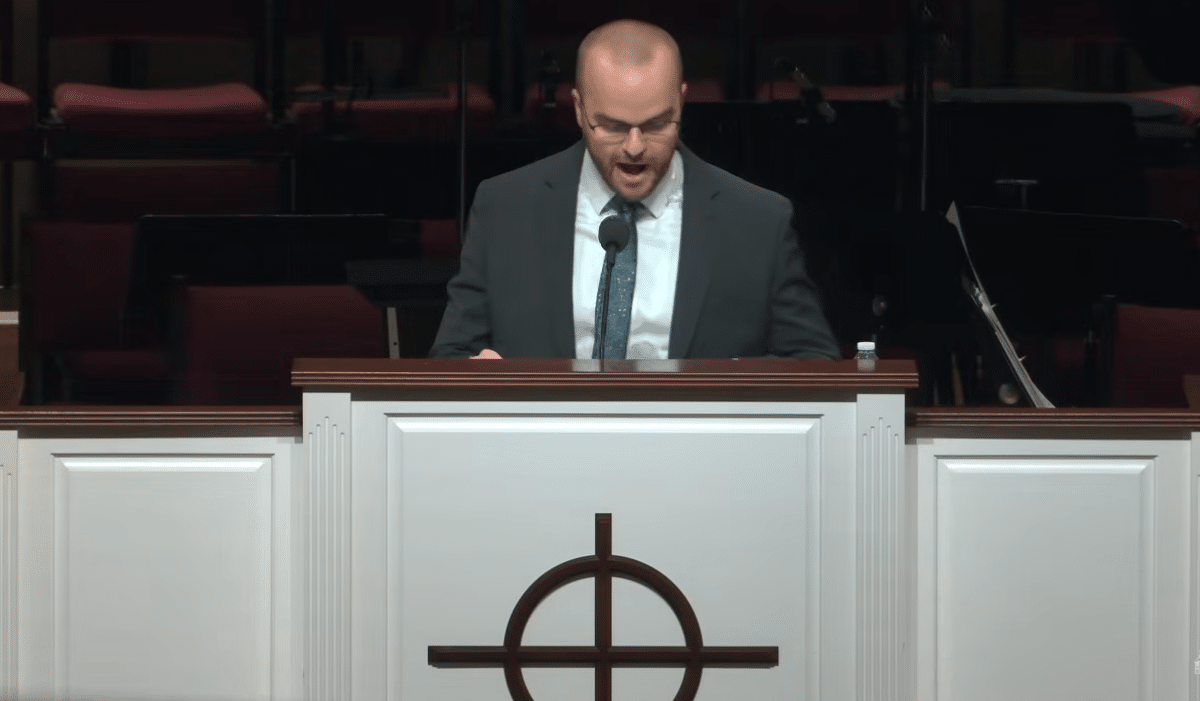
How to Avoid False Witness: Guarding Our Neighbor’s Name
Aaron Andrade, Speaker
| October 25, 2026 - Sunday Evening,
Will you pray with me?
Blessed is he who walks not in the counsel of the wicked, nor stands in the seat of scoffers, but his delight is in the law of the Lord, and on his law he meditates day and night. Lord, as we come to your law tonight to meditate on it, may it be to us a delight, God, not just because it’s on the calendar or it’s the next Lord’s Day in our Heidelberg Catechism, but because we delight to know more of you. Stir in us, Lord, by your Spirit open hearts, listening ears, and bridled tongues, that we may perfectly love you, Lord, and worthily magnify your name. In Christ we pray. Amen.
Well, one of the benefits of having teenage kids is that you have a second chance to reacquaint yourself with the classics. One of my teenagers is reading Pilgrim’s Progress. It was assigned during her high school years. Of course, I never paid attention too much to it when I went through, but if you’ll remember, this is the best-selling classic from the 1600s. So good. If you’re here and you’re a child and you don’t have a copy in your house, tell your parent, do the right thing and buy Pilgrim’s Progress. It’s a good classic from the 1600s. Now, don’t get me wrong. I love modern storytelling. I do. I like a good movie. I appreciate special effects and where we’ve come in terms of cinematography. In some ways, storytelling has really come a long way. I do, though, have one complaint about modern storytelling. Lately, it’s getting harder and harder to figure out who the villain is. Have you noticed this? I mean, I remember when the Wicked Witch of the West was actually wicked. You say, “Well, how do you remember that?” Well, for starters, how about the seven weeks of nightmares I had about those flying vampire monkeys? How about that? That’s one way you can remember. But yeah, it does seem like there’s a deliberate shift taking place. What used to be evil characters have been rewritten by Hollywood as misunderstood. Maybe they’re broken rather than truly evil. Yeah, I miss the days when bad guys were bad guys.
John Bunyan in Pilgrim’s Progress – he got this when he wrote Pilgrim’s Progress. And you know this because as you’re reading, it’s not long before you realize in the story that you can tell a lot about the next character he’s meeting just by their name. So, when you come across Mr. Worldly Wise Man, you’re thinking to yourself, you’re wondering – there’s some skepticism there. And by the time Christian gets to meet the corrupt judge in the town of Vanity Fair, and you hear his name, Lord Hate-Good – now there’s a good bad-guy name. No question, no confusion there. This is Lord Hate-Good. And in case there was any doubt where this is going, we meet his 12 jurors. If you remember their names: Mr. Blind-man, Mr. No-good, Mr. Malice, Mr. Love-lust, Mr. Live-loose, Mr. Heady, Mr. High-minded, Mr. Enmity, Mr. Liar, Mr. Cruelty, Mr. Hate-light, and juror number 12, Mr. Implacable. These guys are all bad guys. You can just tell by the names. Don’t you kind of wish it worked this way in real life? It would make decision-making a little bit easier, wouldn’t it? Sir, I’d like you to meet your brain surgeon that’ll be performing the surgery tomorrow on you: Dr. Wobbly-hands. Yeah, I think I’m going to have to rethink that with the part of my brain that’s still working. Or get to church on Sunday. We’d like to introduce our new interim pastor. He’ll be doing the pulpit supply for the whole summer. Comes highly recommended. Pastor Long-wind.
Now names these days are not tied this tightly to our reputation. Closest we come to this kind of reputational currency is probably ratings. Online ratings. So, if you’ve ever started a Google business page or maybe a Yelp profile, you know what it’s like to worry about your brand name. Soon as you get your page up, you start thinking, “Oof, what am I going to do if I get a one-star rating?” Or maybe you’re a teacher here and you’re wishing you didn’t just find out about this website, ratemyprofessors.com, or at least now you’re worried about it. Or you’re a doctor, and the reputation of your practice is online and able to be under 24/7 scrutiny. Maybe there’s a disgruntled patient who’s lying about you, and maybe they’re smearing your name and putting comments there for all to see. No, when our reputations get attacked, we get nervous. We get that one-star rating, so to speak. And no one needs to tell us in that situation how to defend our names, that it’s important to defend ourselves, right? We will fiercely defend our own reputation and our own name.
But I want you to consider this. When it comes to someone else’s name, when it comes to someone else’s reputation, why is it that we’re nowhere near as zealous to protect their name? Have you ever thought about that? I mean, when it’s our name, we lose sleep. Maybe we can’t eat. We’re consumed with defending ourselves, setting the record straight, maybe even to the point of obsession. But we’re decidedly not that way when others’ reputations are on the line. And it’s not just that we’re casual about that or uninterested, there is a long-standing pattern – we see it all throughout Scripture – of people, God’s people even, deliberately lacking concern for the name and reputation of others. And that’s going to be our focus for tonight as we come to the Heidelberg’s teaching on the ninth commandment. My goal in this sermon is to show you that obedience to the ninth commandment is to carefully guard your neighbor’s name. Obedience to the ninth commandment is to carefully guard your neighbor’s name, their reputation. Let’s go ahead and read the catechism for this evening. If you want to look at it, it’s in your bulletin. This is Heidelberg Lord’s Day 43, question 112. Here’s what it says.
Q: What is God’s will for you in the ninth commandment?
A: That I never give false testimony against anyone, twist no one’s words, not gossip or slander, nor join in condemning anyone rashly or without hearing. Rather, I should avoid under penalty of God’s wrath every kind of lying and deceit as the very works of the devil, and in court and everywhere else I should love the truth, speak it candidly and openly acknowledge it, and I should do what I can to defend and advance my neighbor’s honor and reputation.
So, one thing to point out, the Heidelberg doesn’t actually spell out the ninth commandment. So, I do think it’s worth a reminder, because often we may sort of have the shorthand version of commandment number nine sitting in the back of our minds, thinking “thou shalt not lie.” That is encompassed in the ninth commandment, right? Lying and deceit. We saw that from the catechism. But the actual word for word command from Exodus 20 is this: you shall not bear false witness against your neighbor. I bring this up to reinforce the word “witness,” which is at the heart of the ninth commandment. Now, there’s a lot of places in the Bible where this word “witness” shows up, but as I was preparing for this sermon, I noticed that there’s one book in particular where this word usage skyrockets really intensely, and that’s the book of John, the Gospel of John. This root word for witness shows up 47 times in the Gospel of John. And for context, in the other three gospels, it only shows up 11 times combined. So, it’s not a stretch to say that John’s gospel is like a narrative courtroom. You can think of the gospel story in John a little bit like that, where witnesses of all kinds are making their way to the witness stand, and Jesus’s life and ministry is unfolding through the testimony of these witnesses. Now there are false witnesses out to damage the reputation of Jesus and his followers. We’ll look at some of those tonight. The Pharisees are the classic case, but we also have true witnesses showing us how to keep the ninth commandment and how to guard the reputation of others.
So, let’s start with examples of what it looks like to bear false witness against our neighbor and learn a little bit what that looks like. And we’re going to look at three examples of what that looks like. What does it look like to bear false witness? So, the first example of what that looks like is it looks like rushing to judgment. Rushing to judgment. Here’s how the catechism puts it: we’re not to join condemning anyone rashly or unheard. Rashly or unheard. Why don’t you turn with me to John chapter 7. John chapter 7. We’re going to start in verse 45. I’m going to be picking a few passages from John, again, as we look at this concept of witness. So, turn with me to John chapter 7. We’re going to begin at verse 45. John 7:45. So, here’s what it says.
“The officers then came to the chief priests and Pharisees who said to them, ‘Why did you not bring him?’ The officers answered, ‘No one ever spoke like this man.’ The Pharisees answered them, ‘Have you also been deceived? Have any of the authorities or the Pharisees believed in him? But this crowd that does not know the law is accursed.’ Nicodemus, who had gone to him before, and who was one of them, said to them, ‘Does our law judge a man without first giving him a hearing or learning what he does?’ And they replied, ‘Are you from Galilee, too? Search and see that no prophet arises from Galilee.’”
So, we see there’s one detail the Pharisees have used to make their judgment about Jesus. That’s it. A single detail. They’ve made up their mind. He’s from Galilee, so he must not be the Messiah. Didn’t matter that the officer sent to arrest Jesus came back empty-handed, because they were so taken by his teaching that they just were paralyzed. Couldn’t even arrest him. Here’s what they say: no one ever spoke like this man. Now, with something this unusual, you would think it would cause the Pharisees to take pause and consider listening to Jesus a little closer, but they don’t. They miss it completely. They literally don’t care what Jesus is teaching. Instead, they’ve made up their mind that he’s a deceiver without even hearing him. And it wasn’t going to matter what he said. So, they just wrote Jesus off, made a rash and quick judgment because of where they thought he was from. In their mind, it was a non-starter to even have dialogue seriously with Jesus for that reason. So, we think about bearing false witness. What is it? It’s condemning someone, maybe even just in your mind, without giving them a chance to explain themselves. And it’s really easy to do that these days. I think part of the reason for that is that our minds have been steadily rewired to judge everything around us quickly. Less time, less energy, less thought. You think about it, you know, the articles we read – big, long article summed up in 10 words. Clickable title. You’ve got complex problems people think they can solve in a 140-word tweet, shorts and reels and Tik Toks. You’re disliking, you’re sharing, you’re moving on. What’s next? Just quick snap judgments. We’re used to doing that all the time. And without realizing it, here’s what’s happening: our mindset for how we judge content is spreading to how we judge people. That’s what’s going on. And we have to be careful of this, right? Without realizing it, that’s happening. Someone says, “Oh, he’s lazy.” Yeah. Yeah, I noticed that. I noticed his car looks like a pigsty. She’s an emotional wreck. Yeah. Yeah, I can see that. She got way too worked up at Bible study. Way too worked up. Or he’s kind of rough around the edges. Well, yeah, you know where he grew up, right? That’s just kind of how it is over in that neck of the woods. And that’s how these false reputations take root, right? Just that quick snap judgment that you can make about someone and share about someone that causes another person to think differently about them.
Well, how should it be instead? What’s the right approach? Here’s the way John Calvin instructs us on how it should be: “Let each man estimate by his own disposition.” Let each man estimate by his own disposition. In other words, take the time to learn about someone and who they are yourself. That’s a novel idea. You just might find that as you’re listening to someone firsthand, it’s quite different than your second and thirdhand stories that you’re hearing about that person. Right? And if you look at this passage here, did you notice Nicodemus in this passage – he’s the only one of the Pharisees who’s open to explore what Jesus has to teach firsthand. Remember John chapter 3, he goes to meet Jesus at night, right? What is he doing there? He’s asking questions. He’s trying to learn more. He’s inquiring deeply about his teaching. And then we see here in this passage, he’s pleading with his Pharisees. He’s saying, “Let’s listen to him. Let’s listen to our law, which says that we need to give Jesus a proper hearing.” But they never do. They never do. And if the Pharisees had taken time actually to listen, they would have discovered something very relevant to their assessment of Jesus. He was born in Bethlehem, and he was of the line of David. But they missed it. Why? They rushed to judgment. And this is a very common thing when it comes to false witness. Got to be careful of that. So that’s the first mark.
Second mark of false witness: gossip and slander. Notice the catechism brings in these specific sins, gossip and slander, and it’s right under this ninth commandment, and I think that’s rightfully so. This is where they belong. Now, how do we define gossip and slander? Well, they both happen by spreading negative information about someone. The difference is slander is spreading negative information you know to be false in some way. You’re seeding some lie. You’re twisting it in some way, whereas gossip is spreading negative information even if true. Right? Sometimes we’re gossiping, and it’s actually true information. So, they’re both sinful, but I want you to notice at the heart of these sins is the spreading of information. It’s that instinct that we all have, the part of us that for some reason enjoys publicizing or broadcasting someone else’s faults or difficulties. We’ll come back to that at the end, because I think I can talk a little bit for why that is, but there’s something inside of us that is drawn to or compelled by publicizing or broadcasting someone else’s difficult situation or negative information about them. And this is what leads to gossip and slander.
Go ahead and turn in the next chapter to John chapter 8, and we’re going to look at verse 3, a few verses down. John 8:3. So here’s what it says: “The scribes and Pharisees brought a woman who had been caught in adultery, and placing her in the midst, they said to him, ‘Teacher, this woman has been caught in the act of adultery. Now in the law of Moses, it commands us to stone such women. So, what do you say?’ This they said to test him, that they might have some charge to bring against him.” So, this example could not be more fitting. The Pharisees, they hatch a plot to bring this woman’s sexual sin out into the open. They decide to publish her activities to a group of strangers, a bunch of men she’s never met, bring her to the public square, and all for their own ulterior motives. They care nothing for her wellbeing. She’s a pawn in their scheme to catch Jesus, and they’re very glad to publicize her adultery to everyone that’s there. Here’s the question we need to ask ourselves if we really want to stop the gossip train. Here’s the question. Even if the information that I found out about this person is true, even if, as Calvin puts it, they deserve their ill name, is this something that I need to spread to others? Do I need to say this? Does anyone else really need to know this information? To ask that question, and I think it’s rare, is to change the conversation, right? When you’re in a conversation, it’s hard to do that. It’s going down the road of gossip. You’re going to stop it. It’s hard, right? It will take a holy determination for us to prevent gossip from continuing in the groups we’re a part of.
In his book, Memoirs of an Ordinary Pastor, DA Carson writes about his father Tom Carson. In one of the chapters, Tom is dealing with a major crisis as he worked to establish his small church plant. A once-trusted colleague who was in charge of funding for his church plant abruptly cut off his funding, leaving Tom with no salary and a large amount of debt that he incurred. And the man’s motive was entirely political because of a perceived slight. So, what did Tom and his wife do? Among other things, one thing they did which took precedence was it was clear that the relationship was not going to be repaired, and so Tom and his wife wanted to guard the name of this person who offended them. So, they took a vow together, a vow that neither of them would ever say anything unkind about this man. They refused to make the offense public. They refused to speak ill of him at all. That’s what it looks like when it comes to gossip. You have to find ways of drawing lines in the sand. I’m not going to talk about this person when they’re not here. I’m not going to spread that. I don’t need to say that. These are the kinds of commitments we have to make. And yes, it will be awkward sometimes, redirecting a conversation when your friend you know is excited to tell you this big, juicy story about what happened to so-and-so, but there’s important things that we need to learn from Scripture, and that’s one of them – that this is gossip. This is a category that is not something that behooves a Christian. Here’s what Proverbs 10:12 says, “Hatred stirs up strife, but love covers a multitude of sin.” The false witness does the opposite of that. The false witness uncovers even the most minute of sins. Do you see that? Instead of covering a multitude, they’re uncovering the most minute of sins. That’s what a false witness and a gossip does – looking for accusations, snooping around, asking questions. Why? To uncover things that we and then spread, right? So, that’s the second mark.
The third mark of false witness, here’s what it looks like: twisting someone’s words. Twisting someone’s words. And here’s where the stakes get raised for why we really, really need to avoid bearing false witness. At its worst, false witness is using the devil’s blueprint. That’s what it is. The catechism puts it well. When we behave this way, we employ the devices the devil himself uses. The devices that the devil himself uses. Turn a few verses later in the same chapter, John chapter 8, to verse 43. Look at the way Jesus addresses the Jews and the Pharisees and the scribes: “Why do you not understand what I say? It is because you cannot bear to hear my word. You are of your father, the devil, and your will is to do your father’s desires. He was a murderer from the beginning and does not stand in the truth because there is no truth in him. When he lies, he speaks out of his own character, for he is a liar and the father of lies.” Jesus does not pull punches here, right? He does not pull punches. The devil is the father of lies. And there’s a reason Jesus is very harsh in this way. When we’re bearing false witness, especially when we twist someone’s words by intentionally or carelessly removing important context, let’s say, or sharing only part of the situation, or forgetting conveniently one part of what’s been said, right? When we’re twisting those kinds of things, twisting words, it’s not a neutral thing. We’re exhibiting recognizable and verifiable patterns, the pattern of the devil.
I called into USAA recently while navigating the phone menu, and I noticed that the IVR lady says, I’d like to give you the opportunity to have a more secure way to verify your identity. Oh, interesting, I say. I’ve heard of a PIN, of course; you’ve heard of a verbal password, but this was the first time I’d been asked and she said to record a voice print. A voice print. That’s right. Just like a fingerprint, it’s just that your voice is apparently unique to you, and there’s no way that anyone else can possibly fabricate your voice print. I don’t know about that. I mean, I’m thinking AI. I mean, there’s got to be a way. Someone impersonating you. I mean, I was skeptical of it, right? But why can’t they make a – when you think about the devil, right, and you think about what we’re doing when we have this kind of false witness, when we’re twisting words, okay, is that we are literally taking the voice print of the devil and using it in our speech patterns. That should make us shudder, right? His pattern of speech is to twist people’s words, so when we go down that path, that’s what we’re doing. We’re using the devices of the devil. Think about it. Think about Genesis in the very beginning in the garden. What does he do? He twists God’s words, right? Did God really say? Or even in Mark when we think about the temptation of Jesus – he’s in the wilderness, and what does the devil do? He twists the context of Psalm 91, trying to get Jesus to test God, right? This has no part in a Christian’s life, and this is a big part of what it looks like to bear false witness.
So, the Pharisees, they provide a master class in false witnesses, and you can see a pattern for what it looks like to break the ninth commandment. Rushing to judgment, gossip and slander, twisting people’s words. And if you’re like me and you’re reading all that, you feel convicted, because this is an area where I think for most of us as Christians, we may be a little more loose than we should be, right? We’re realizing now how careless we may have been with our speech and thinking about protecting the name of our neighbor. Also though, I think in a group our size, I’d bet there’s some people here listening where it’s you who’ve been the one that’s been slandered. You’re the one whose words have been twisted. Maybe you’ve been blindsided by someone you thought you could trust going about a smear campaign against your name or someone close to you has been dragging your name through the mud and you didn’t realize it. This can be an absolutely gut-wrenching experience, and if you’ve been through it, you know what that’s like. How are we to respond in those cases? What does this passage, what does this Heidelberg teach us about what it looks like to bear true witness? I mean, thankfully, we don’t just have the Pharisees and their pattern of false witness – what not to do. We also have Jesus and his pattern of what we should do. So, how do we guard our own name? And then I’ll look at how we can expand that into guarding our neighbor’s name.
So, guarding our own name in the face of false witnesses – what does that look like? When you’re enduring false witness against your name, of course, the first thing to do is think about whether there’s a time and a place for you to simply go to that person and set the record straight, right? To contend for the truth in a straightforward conversation. That’s always useful, and it’s one of those things that we sometimes don’t really remember, right? If you think someone has something against you, go to the person, right? Matthew 18. But what if this isn’t possible, which is actually often the case as well? Tensions are so high, feelings are so hurt that there’s no opportunity for this kind of setting the record straight. Well, let’s go ahead and turn to John chapter 5. John 5, we’ll look at verse 31-40. We read some of this in our gospel reading earlier today, our New Testament reading, but I just want to reread it here. John chapter 5, we’re going to start at verse 31. Here’s what Jesus says about his own witness:
“If I alone bear witness about myself, my testimony is not true. There is another who bears witness about me, and I know that the testimony that he bears about me is true. You sent to John, and he has borne witness to the truth. Not that the testimony that I receive is from man, but I say these things so that you may be saved. He was a burning and shining lamp, and you were willing to rejoice for a while in his light, but the testimony that I have is greater than that of John, for the works that the Father has given me to accomplish, the very works that I’m doing, bear witness about me, that the Father has sent me. And the Father who sent me has himself borne witness about me. His voice you have never heard, his form you have never seen, and you do not have his Word abiding in you, for you do not believe the one who he has sent. You search the Scriptures because you think that in them you have eternal life, and it is they that bear witness about me.”
Notice the four things that Jesus uses to bear witness of himself: John the Baptist, his works, the Father himself, and the Scriptures. Now, what parts of Jesus’s pattern here in John 5 can be instructional for us? How can this example that he set help those of us who are enduring false witness? Three observations. First, others can bear witness on our behalf. You see that? John the Baptist bore witness to Jesus. He knew Jesus, as did his disciples who were with him every single day. They were in perfect position to bear true witness about who he really was. The question we can ask ourselves when we’re being maligned, when our reputation is on the line, when we’re being attacked for no reason – ask yourself, can other people outside of the situation help bear witness about me? Could those who know my character help? So that’s one.
Second, our works can bear witness for us. Jesus pointed to his works as witness. Now, of course, you’re not a miracle worker, but you can let your good works speak for themselves. What do I mean by that? Well, Jesus says, “You will recognize them by their fruits, and every healthy tree bears good fruit.” Have you built a pattern of good works done in Christ? Is there some history demonstrating your godly character? If so, it’s possible that pattern can speak much louder than a battle of words between you and this person. Getting deeper into a tense conversation with somebody can sometimes lead to danger, right? Here’s what happens: you get baited into an exchange that ends up staining the very reputation you were trying to defend, right? Sometimes that happens too. Proverbs 10:19, “When words are many, transgression is not lacking, but whoever restrains his lips is prudent.” Instead, guarding your name and bearing true witness can be just letting your works do the talking, right? Letting your works do the talking.
Number three, finally, Christ pointed to Scripture about his identity, and we can do the same thing. When we’re wrestling with nasty false accusations that are untrue, because let’s face it, there’s a particular kind of pain that comes with this kind of thing, right? Being misunderstood, misaligned is painful. It can cause a lot of mental heartache. If we’re not careful, though, we can spend more time trying to figure out what this person is saying about us or even what this person believes about us instead of what God says about us, instead of what God believes about us. That’s what can happen. And so, Christ, he points to Scripture to say, I know who I am. The Scriptures point to who I am. And you as a believer, your identity is captured in Scripture as well. It’s a wonderful remedy to dealing with false lies. Open your Bible. Come to Scripture. It’s the only record that will endure for all of eternity. What does Scripture say about you in Christ? That’s what matters. That’s what matters in the end.
So, finally, let’s talk about guarding our neighbor’s name. I said at the beginning of this sermon that at the heart of keeping the ninth commandment, that’s what it’s about. It’s about guarding our neighbor’s name. And how does Christ give us a better pattern for that? Because you might be saying, “I get that we’re not to bear false witness like the Pharisees, and instead we’re to follow Jesus’s pattern, but does that mean I simply don’t address my neighbor’s sin? Does that mean that in this newfound zeal for guarding my neighbor’s name that we never call out sin?” No. Of course not. No. Here’s what we can learn, though, from Jesus, right? Here’s how Jesus guarded the name and reputation of others. I want you to think about this passage we read in John chapter 8 about the woman caught in adultery, and I want you to think about – we won’t go there – but just think about the contrast between the way the Pharisees handled that woman and how Jesus handled the adulterous woman at the well, the Samaritan woman in John chapter 4. In that story, right, the Samaritan woman is at the well, but rather than plotting and scheming for maximum public shame like the Pharisees did, Jesus goes to the well when? In the middle of the day. He meets her at a time when he knows that no one else will be there drawing water. He knows that she’ll be there by herself, that it won’t be public. Even more discreetly, if you notice from that passage, Jesus talks to her without his usual entourage. The disciples weren’t even with him at the time. We learn from the passage, they didn’t even know what he was talking about with her. Again, an additional layer of containment. In the conversation itself, he also doesn’t make her provide every detail, does he? It’s enough for her to know that he knows all those details.
So, this is a pattern that Jesus provides that’s better, much, much better than the pattern of the Pharisees. Here’s how Calvin addresses it to those who are confused, right? Do I address sin, or do I not? Here’s what he says: “Moses points out a more useful remedy in the Old Testament, that they should bring back wanderers into the way by private rebukes and not by publishing their offenses.” And of course, this is the biblical pattern laid out in Matthew chapter 18, right? The first step for two people who know of an offense to discuss it themselves. You could win your brother at that level, just the two of you. If that doesn’t work, and only then, you bring someone else in, a third person, right? And at that point, you see whether you can come to an agreement. And then, if that still doesn’t work, that’s when you bring it to the church. Now sometimes the case is that it’s a public sin or someone in public office, and in those cases, you do need to deal with that on a public level, but most of the time, the things that we’re dealing with can be contained, and they don’t need to be published, and we can use similar patterns to what Jesus taught us and the way that he conducted himself.
So, I want to circle back to the question we started with in the beginning: why is it that we do this? Why do we bear false witness? Why is false witness even a problem? I mean, we know how to defend our own names incredibly well. We’re pretty much experts in that. We know how. Well, I believe in each one of us, the reason that we bear false witness, one of the reasons is because there’s a suspicion that we carry. We have a sense that it’s not just Christian and Faithful who are before a judge in Pilgrim’s Progress, but someday we all will find ourselves in that place before the judge. And I believe there’s a fear we carry that who we are won’t be good enough, that when we stand in judgment before God, our real names will be exposed. Mr. Lusty-eyes, Mrs. Never-trust, Miss Rebel-heart, Mr. Lukewarm. That’s what we’re afraid may happen, just an inkling in the back of our mind. So, what do we do? How do we improve our name and our reputation? Here’s what I think happens. We start believing even at a subconscious level that God’s scale will be a sliding scale. I just need to show that my name is not quite as bad as someone else’s name. This is why when you talk to unbelievers about why they’re hopeful that they’ll get into heaven someday, here’s what you’re likely to hear. They’ll very, very quickly point out, “I’m not perfect.” 99% of the time, that’s what they begin with. I’m not perfect, but – and what comes next? I’m surely not as bad as some of the people I know. And they’ll go through a list that they have in their minds of all those people that are worse than they are. And part of why we bear false witness against each other and tear down the names of others is because we’re trying to get to that upper 50%, so that on that sliding scale when we come before the throne of judgment, that God Almighty will say, “Okay, you made it to the good half.” But the truth is, we’ll never, ever earn for ourselves a name good enough for God Almighty.
But here’s the good news. John 1:12, “But to all those who did receive him, who believed in his name, he gave the right to be called children of God, who were born not of blood, nor of the will of the flesh, nor of the will of man, but of God.” If you want the right to have the name, the name above every name, the name Jesus bestows on all his elect, it doesn’t come by tearing down the name of others. It comes by faith. Believe, and you will have the right to be called a child of God. This was his glorious plan from the beginning to redeem for himself a people, a people condemned with an old name that receive a new name. He designed it this way. This is exactly the plan of salvation, and he does this because he wants to show that for us, God gives us the name of saint because Jesus took on the name of sinner. They called him a deceiver. They called him a drunk. They called him the devil himself. They gave him a grave with the wicked. He was numbered with transgressors, the Word says, crucified next to thieves. They mocked him. They scorned him. They spit on him. They trampled his name. That’s what he got. And why? So that by faith you could get this name: elect, faithful, redeemed, holy nation, royal priesthood. Do you want those names? Don’t go for it by tearing down the name of others. No, by faith receive the gift, the name “child of God,” and he will guard it, and he will give you the power to guard your neighbor’s name as well.
As the story progresses for Christian and Faithful, they come to the end of the sham trial, and judge Lord Hate-Good pronounces Christian’s friend Faithful guilty, and as the story goes, they scourged him, they beat him, and then they lanced his flesh with knives. After that, they stoned him with stones and then pierced him with their swords. And last of all, last of all, they burned him to ashes at the stake. In this manner, Faithful came to his end, but as for Christian, he escaped them in due time and went his way. And as he went his way, he sang, saying, “Well, Faithful, you have faithfully professed unto your Lord with whom you shall be blessed. When faithless ones with all their vain delights are crying out under their hellish plights, sing Faithful, sing, and let your name survive, for though they killed you, you are still alive.” Let’s pray.
Lord, your Word has gone out. May we be doers of it. Remind us this week in our conversations to guard each other’s good name, to speak truth openly and candidly, to bless others, to lift them up, to encourage them in Christ, that all your children would dwell in unity just as you do, Father, Son, and Holy Spirit. We ask this in Christ’s name. Amen.