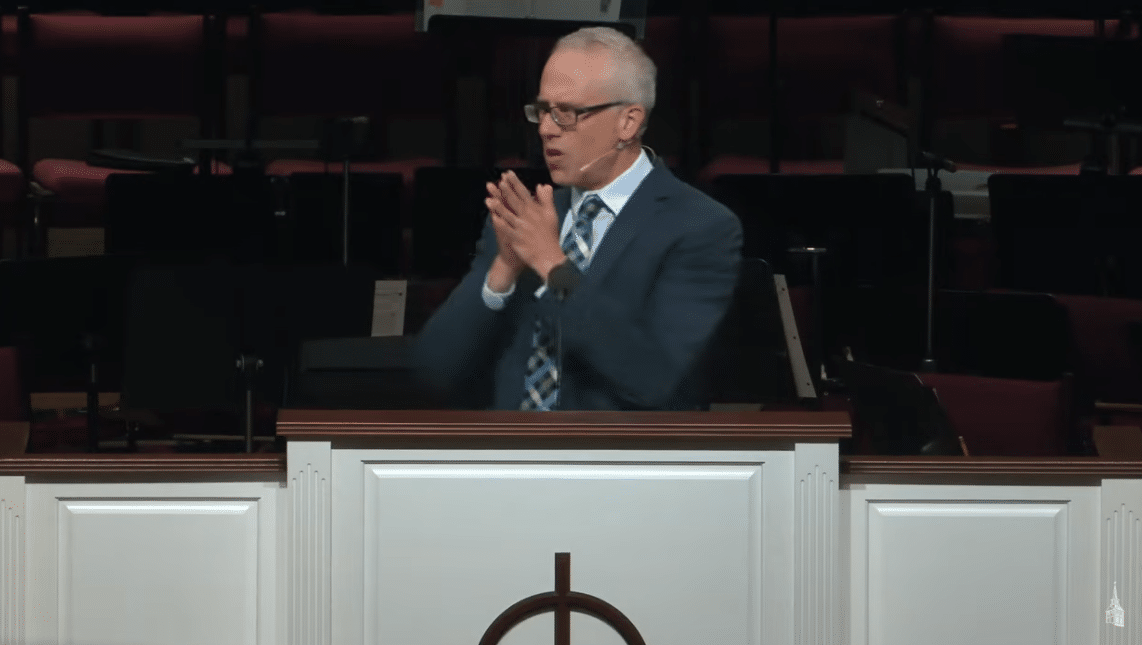
How to Think About “Things”
Tom Groelsema, Speaker
| October 18, 2026 - Sunday Evening,
As we prepare to study God’s Word together, let’s pray before we read from the text and from the catechism.
“O how I love your law,” the psalmist says, “It is my meditation all the day.” Lord, your commandments, they make me wiser. They make us wiser than our enemies. We have more understanding than all of our teachers. We understand more than the aged. But sweet are your words to our taste, sweeter than honey to our mouth, for through your precepts, we gain understanding. And therefore, Lord, teach us to hate every false way. And so, Father, as we think about the eighth commandment tonight, we would pray these truths, and we pray these things in Christ’s name. Amen.
Please turn to with me in your Bible to Ephesians 4. Ephesians chapter 4. I want to read tonight verses 25-32. Our focus is just on one verse, verse 28. We’ll read the surrounding verses, surrounding context. Ephesians 4:25-32. And then after reading that, let’s turn in our bulletins to read together the two questions that are from Lord’s Day 42. So, hear now God’s Word.
“Therefore, having put away falsehood, let each of you speak the truth with his neighbor, for we are members one of another. Be angry and do not sin. Do not let the sun go down on your anger, and give no opportunity to the devil. Let the thief no longer steal, but rather let him labor, doing honest work with his own hands so that he may have something to share with anyone in need. Let no corrupting talk come out of your mouths, but only such as is good for building up as it fits the occasion, that it may give grace to those who hear. And do not grieve the Holy Spirit of God by whom you were sealed for the day of redemption. Let all bitterness and wrath and anger and clamor and slander be put away from you, along with all malice. Be kind to one another, tender-hearted, forgiving one another as God in Christ forgave you.”
Look at verse 28 again, “Let the thief no longer steal, but rather let him labor, doing honest work with his own hands, so that he may have something to share with anyone in need.” And then those two questions that come from Lord’s Day 42 of the Heidelberg Catechism. Let’s let me read the question and answer for you. The answers are a little bit long, maybe a little bit difficult to stay together with them. So, I’ll just read the question and the answers for us tonight. So, what does God forbid – question 110.
Q: What does God forbid in the eighth commandment?
A: He forbids not only outright theft and robbery, which governing authorities punish, but in God’s sight, theft also includes all evil tricks and schemes designed to get our neighbor’s goods for ourselves, whether by force or means that appear legitimate, such as inaccurate measures of weight, size, or volume, fraudulent merchandising, counterfeit money, excessive interest, or other means forbidden by God. In addition, God forbids all greed and pointless squandering of his gifts.
Q: What does God require of you? (So, first question, what does God forbid? Now, what does God require of you in this commandment?)
A: That I do whatever I can and may for my neighbor’s good. That I treat others as I would like them to treat me. And that I work faithfully so that I may help the needy in their hardship.
Well, people of God, every now and then it’s good to move. And what I mean by that – it’s good to change houses. It’s good to change cities. It’s not an easy thing to do, but I would suggest that it’s good for the simple reason that when you move, you have to deal with all of your stuff. All of your things. Moving forces you to sort, to scrap, to dispose, to downsize, all those things. And so, every once in a while, it’s a good thing to move. I remember when Sheri and I were moving six years ago from Michigan down here to Charlotte, we created four piles for our things. Pile number one, move. This was stuff that was coming with us. Pile number two, junk. It’s going to the landfill. Pile number three, the thrift store. Pile number four, Facebook marketplace. So, went through all of our stuff – that goes here, this goes here, that pile, that pile. It’s how we did it. And when you go through an exercise like that, you soon realize, of course, how many things you have.
Thinking about things probably is a particularly Western exercise. Can’t really imagine that people in Central America or people who live in Haiti think much about their things. Things are a blessing, of course, but they can easily rule our life. We need bigger garages to fit our things. The more things we have, the more they break down. They fall apart. They have to be maintained. With many things comes worry. We need bigger incomes to keep up with our things. When the economy slumps, we’re quickly in trouble due to our things.
Well, what do you think the eighth commandment is about? It’s about our things. It’s about our stuff. We have to be clear that the eighth commandment is not against having things. Rather, the eighth commandment is about the place that things have in our hearts and our lives. It’s about whether we possess things or things possess us. For as Jesus said, where our treasure is, our heart will be also. So tonight, what I want to do with you is think about four attitudes from the eighth commandment that we can take towards our possessions. Or another way of putting it is four ways to think about things.
Here’s number one. This would be one attitude. Not recommending it, but it is one attitude. What’s yours is mine, and I’m going to take it. What’s yours is mine, and I’m going to take it. Of course, what that is about is stealing, and that is what the eighth commandment is obviously about when God commanded us, “Thou shalt not steal.” And it’s something that not only God commanded in the Ten Commandments, but we find it throughout Scripture. It is something that Paul addresses here in Ephesians 4. I wanted to read those verses around verse 28, because you pick up very easily, right, this long list of things that we are commanded to put off. We are to put off anger, put off corrupting talk, bitterness, clamor, slander, all these sins that as we’re reading through that list, we say, “Those are very common. I feel those. I experience those. I do those. And God calls me to put them off.” But then he adds, “And do not steal.” I don’t know about you, but when I read that, I say, “Well, I don’t think that’s one of my major problems.” And even though Paul was writing to believers here, to the church, he realized they needed this reminder, and we need this reminder.
In Ephesus, it seems that stealing was some kind or some sort of an ongoing problem in the church, and authors or biblical scholars think for this reason. It was probably a problem particularly for those who had been slaves. They’ve been slaves. They had been used to stealing, taking from their master, maybe being lazy with their time, and then they became Christians. And yet that old way of life didn’t always change. Paul says, “If you’ve been stealing, stop. That’s part of the old way of life. That is not the new way of living that you are to take on. You were called to a new way of life as a believer. Put it off.” Friends, what’s yours is mine – it’s rather obvious, but “what’s yours is mine, and I’m going to take it” is never a legitimate option for Christians.
That command – thou shalt not steal – it has a wide application, and it’s probably good for us to kind of think about, alright, how does this command play out in our life? What does it forbid in our living? And the Heidelberg Catechism helps us with this. It says God forbids outright theft and robbery. We can take that command or those words, and we can bring them into the world of work. Think about punching in early, and then you kind of hang around before you actually go to work. Or you kind of quit working and take a little while and then punch out late. Or think about filling in a false time card or calling in sick, when really all you’re doing is taking a personal day for yourself. Or you claim credit for something that you didn’t do. It’s kind of in the world of writers or maybe pastors or teachers. We think about plagiarism. We think about the world that we’re living in today and how easily this can be done with the prevalence of AI. All part of this command. Take this command in the world of business and how we might overcharge others for services that we’ve rendered, or we do not pay our employees a fair wage or give our employer a fair day’s labor. Think about something extreme as embezzlement. Take it into our home life, and you borrow that shovel from your neighbor, and you just never seem to bring it back to them. Or you take a student loan, and you don’t repay it. You file a false or shady insurance claim. Cheat on an exam. Fail to report income on our taxes. Or we can bring it into the world of our worship. As Malachi reminds us, if we fail to give God our tithe, we’re robbing him. Or sometimes we squander away God’s gifts. We just waste them frivolously, spend them away.
And the Heidelberg Catechism, it even gets more subtle than that. Talks about inaccurate weights, measures, fraudulent merchandising, counterfeit money, excessive interest – things really, as you read through that latter list, things that really sort of, I think, kind of bear the stamp of time, right? We don’t think about excessive interest much anymore. And yet you sort of take those parts of the command or those ways of applying the command, and you can think about modern ways that these sort of things happen. Heard recently about somebody was selling a home with a major hidden defect, and they failed to disclose it. And I think they would have said, well, you know, nobody demanded an inspection. And it’s of course bearing false witness about what you’re selling, but there’s also a portion of it about getting a price that you really didn’t deserve, taking from someone what was theirs. And that’s what this command is about. It forbids whatever means we take to wrongfully attain another’s possession. And this of course is a sin both against God and our neighbor. It’s a sin against God because we fail to trust his provisions. And so, we think we need to take, and we need to rob, and we need to care for ourselves. And it’s a sin against our neighbor because we take God’s provision for them from them. And it’s a command that intersects with so many of the other commands. Nearly every violation of the Ten Commandments involves some kind of theft. We bow down to idols, and we steal God’s worship. We break the Lord’s day, and we steal his day. We murder and steal life. Adultery steals purity. Lying steals truth. People of God, all of this probably is rather obvious to us, and yet, we need to hear it. One author said in commentary on this commandment – kind of hard to believe, but I’ll take his word for it – he said, “90% of evangelical Christians say they never break the eighth commandment.” Now, if that’s true, or even close to it, we need to hear these things, right? What’s yours is mine and I’m going to take it. One attitude.
Number two, what’s mine is mine, and I’m going to keep it. What’s mine is mine, and I’m going to keep it. This deals of course with selfishness and greed. And the Heidelberg Catechism points out that this too is part of the eighth commandment because beyond outright theft and robbery, in addition the catechism says, God forbids all greed. This is where the commandment of course drills down even deeper. I don’t know how many of you have seen recently – you’ve been out and about, maybe you stopped at the pharmacy, or you’ve been at a grocery store, or maybe you seen an advertisement somewhere – but all these reminders to get your flu shot, right? It’s flu season, so get your flu shot. Now, we might worry a little bit about influenza, but there’s an equal danger for us with affluenza. Our affluence, having so much, materialism, needing, wanting more. And of course, the two often get confused in our minds, right? What we want, we think we need. And now that may be true, if we’re trying to keep up with all of our wants. But the reality is that often what we want is not necessarily a need in our life, and we’re bombarded by things that confuse those two things in our minds. Commercials, advertisements, the way that stores display their goods feeds our wants, the colors that restaurants adorn themselves with psychologically affect us and make us hungrier than we were before we visited the restaurant. The need for more and more. And we have to say, I think, tonight, even our cultural environment. So, living in South Charlotte doesn’t help you with contentment. You live somewhere else, and it may be a little bit easier.
Do you remember the parable that Jesus taught in Luke 12? The parable of the rich fool. This rich man who didn’t know what to do with his crops, and overflowing with them, he says, “I’ll tear down my barns. I’ll build bigger ones. And then I’ll store my grain and goods, and I will say to my soul, ‘Soul, you have ample goods laid up for many years. Relax, eat, drink, be merry.’ And God will say, ‘You fool, for this very night your soul will be required of you, and the things you have prepared, whose will they be?’” The parable, of course, is not just about the size of the man’s barns. In fact, that’s probably not the real issue. The real issue in the parable was the size of his heart. The size of his heart for God. Wealth had crowded out God. And so, the way even this rich man goes about speaking, all of the I’s – I will say to my soul, I will tear down my barns, I will build bigger ones, I will store my grain and my goods. This is a self-sufficient man. Doesn’t need God. And the only person that he talks to in the parable is himself. He doesn’t talk to God. God is out of the picture in his life. It’s all about him. There’s a man who is saying, “It’s mine, and I’m hanging on to it. I’m going to keep it.” It’s not having a lot of things that is the problem. Remember how Timothy says it is not money, but it’s rather the love of money that is the root of all kinds of evil. When our children were little – I don’t know if you’ve done these kinds of things, but you know, you’re trying to teach them spiritual lessons, and maybe you’re giving them some visual aids or an exercise to go through – but one of the little lessons about contentment we tried to teach our kids: so we put a big jar full of candy out on a table, an end table, you know, a number of paces away from them. And we had a timer, and when we said go, they could go get a piece of candy, and then they could bring it back to their bowl across the room, and they could keep doing this as long as there was time. Of course, they didn’t know how much time was left. And the tricky part was this: if they were touching their bowl when the timer went off, touching their own bowl when the timer went off, they could keep all of their candy. But if they were not touching their own bowl, they have to give all the candy back. So, how many times do you dare grab a piece and run back? And when’s the timer going to go off? And can you be content with just a few pieces and sort of stop and say, I’m just going to hang on to my bowl? So, that second attitude, what’s mine is mine, and I’m going to keep it is not what this command teaches us to do.
Third attitude, what’s mine is God’s, and I’m going to receive it and use it with thanksgiving. What’s mine is God’s, and I’m going to receive it and use it with thanksgiving. This is the positive side of the eighth commandment. But this command really gives us a lesson in stewardship. What I’ve been given belongs to the Lord, and I’m going to use it for his glory. A steward is someone who cares for someone else’s property. Not free to use it as he pleases, but only to manage it in accordance with the master’s intent. To be a steward means recognizing that God owns everything. God owns the money in my wallet. God owns the shirt on my back. God owns the house I live in, the car I drive, the money that’s in my bank account, and everything else. It means taking care of all that I have been given, using it in a way that would please God.
The Heidelberg Catechism, another point – what does God forbid in this command? He forbids the pointless squandering of his gifts and therefore by implication on the positive side, the good use of God’s gifts. Friends, to help us remember this, that we are stewards and what is ours is the Lord’s, we just have to remember that we are pilgrims, right? We came into this world with nothing, and we’re going to leave this world with nothing. It’s a great reminder to Israel, every certain number of years when the Year of Jubilee came, where land would revert back to someone from whom it had been bought, and you’re reminded at these intervals, right? This is not yours. This doesn’t belong to you. You can’t keep a tight grip on it. But you are a steward, not the permanent owner. The stewardship is not intended to take the gladness out of the gifts that God has given to us. In other words, it’s not to ruin our joy when we think about ourselves as stewards. The Apostle Paul said to Timothy, “God has given all things for us to enjoy.” We ought to enjoy what God has given us, but we simply need to be good stewards of it and thankful people for it.
An implication of stewardship that is also on the positive side of this command is that we are called by this commandment to honest work. We are called to be workers. Isn’t that what Paul said here in Ephesians 4? He says, “Let the thief no longer steal, but rather let him labor.” The other side of stealing, of taking what is not mine and making it mine, is to be a worker. And this is the very thing that God called us to do from the beginning of time. Genesis 1:28, we’re to be fruitful and fill the earth and subdue it and have dominion over it. And in the next chapter, Genesis 2:15, God put man in the Garden of Eden to work and to keep it. We are called to be caretakers of the creation. We were created to be productive. We are to be developers. We are to work hard. We are to take the creation and use it and magnify it and multiply it for the glory of God. So often we think about work in the context of the fall. Maybe not theologically or outright, but that’s sort of the impression, right, that we sometimes get. Work, after all, is a four-letter word. Genesis 3:19, yes, reminds us, by the sweat of your face, you shall eat bread. In other words, work is hard, but it did not arise after the fall. It is part of God’s good creation. And so, this commandment calls us to be good workers, to work hard. We often hear today about work-life balance. And of course, it is important to be balanced, and what that phrase generally means, of course, is don’t work too much, right? Don’t overwork. Don’t let it dominate your life. And yet, we ought to be able to apply it the other way as well, right? Too much play is not good either. Balance work, balance life. Just let me thank you tonight for the sabbatical that you gave to Sheri and I. It’s a great gift from the church, and in one portion of our sabbatical, we spent three weeks on the coast. And so, most of those days, our biggest decision is what time do we want to go set up the Shibumi and sit under it and read? I said to Sheri at one point along the way of that sabbatical – I said, “You could not keep doing this the rest of your life.” There’s a time to go back to work. It’s wonderful on a sabbatical. It’s great for a vacation, but this is not the way you’re supposed to live life. We’re called to work as well as rest. And Paul’s answer to stealing is work, labor. Calls it honest work. Be productive, not to take from others, but rather work so that you can give to others.
And that’s the final point tonight. It’s the final attitude. What’s mine is yours, and I’m going to share it. What’s mine is yours, and I’m going to share it. Now, this is not a word against private property. Don’t understand me in saying that. But rather, this is a command that urges generosity, that urges us to give. And so, the Heidelberg Catechism, what does God require of you in this command? That I do whatever I can and may for my neighbor’s good, that I treat others as I would like them to treat me, that I work faithfully so that I may help the needy in their hardship. Or back to Ephesians 4, “Let the thief no longer steal. Rather, let him labor, doing honest work with his own hands, so that he may have something to share with anyone in need.” I wonder how often we think about our work in this light – that our work, yes, it’s about paying our bills. It’s about meeting our needs. But our work is also a channel to help us to be more merciful to those who are in need. When we are blessed, it’s not simply to raise our standard of living. It’s also to raise our standard of giving. And of course, the eighth commandment prohibits taking, but it prompts and commands giving. And this is something that marked the early church. When you go to Acts 2, and you find the description of the early church in its earliest days and kind of the pillars that were part of the early church – Acts 2:44-45 – one of the earliest pillars of the church and the impact of the gospel on those early Christians was that all who believed were together. They had all things in common. They were selling their possessions and belongings and distributing the proceeds to all as any had need. The impact of the gospel right from the get-go was hearts that were breaking open to share, to give. How are you doing, brother? Sister, you have a need? How can I help you? A benevolent heart.
The church that I grew up in, and actually some of the churches that I’ve served, often when we would celebrate the Lord’s Supper, there was a following – in the service – a following benevolence offering or a mercy fund offering. Celebrating the Lord’s Supper? Our response: we’re going to help those who are in need. What a great practice. Friends, we’re called to live generously. How much? A tithe? No exact command in the New Testament how much we ought to give. Jesus said once to the teachers of the law, “You tithe on your mint and cumin but neglect the weightier matters of the law.” Jesus saying there, pay attention to those weightier matters. Don’t stop tithing, but pay attention to those weightier matters. The Apostle Paul reminds us that God’s blessings have overflowed to us so that we might overflow to others. And he reminds us of the riches we have in Christ, who became poor for us, so that we would contemplate the gospel as we think about giving and allow the gospel to be our motivator and the standard that drives what we would give. Generous giving – it breaks the hold that money can have over us. We’re prone to grip it and say what’s mine is mine, and I’m going to keep it. It’s giving that loosens that grip. As Kent Hughes said, “Every time I give, I declare that money does not control me. Perpetual generosity is a perpetual de-deification of money.” What a great lesson for us. What a great lesson to teach our children. Parents, something you could do is whenever that offering bag goes by or the offering plate goes by, don’t leave it empty. Just if it’s a nickel, put it in there. Teach your children the pattern of giving to others.
Well, friends, let me close with this, that our obedience to this command and all of the commands of course is always rooted in the gospel, what Christ has done for us, how he has redeemed us and saved us. And in that light, think about Jesus, where he was crucified. He was crucified between two thieves. And of course, it wasn’t just two thieves that were on those crosses, but it was three. Isaiah 53 says he was numbered with the transgressors. He was counted as a thief. Two, of course, punished for their own crimes and one who took the crimes of others. Jesus, the innocent one, taking our sins on himself. What a comfort, then, for anyone who has broken the eighth commandment, which no doubt is all of us here tonight. Forgiveness at the cross. May the gospel remind us of how truly rich we are, and as a result, help us to live with a right attitude toward things. Let’s pray together. Father in heaven, we praise you for all that you have given to us. Our cups overflow. Your hand is open, and out of your hand pour forth blessing upon blessing and gift upon gift. And so, Lord, we pray that we would not be ruled by our things, but we would rule over them. That we would not have that attitude, “what is yours is mine, and I’m going to take it” or “what’s mine is mine, and I’m going to keep it.” Rather, that we would have the perspective, “what’s mine is God’s, and I’m going to receive it and use it with thanks, and what’s mine is yours, and I want to be generous to share.” So do this work in us, Lord, by the power of your grace, the work of your Holy Spirit, the motivation of the gospel. In Jesus’ name we pray. Amen.